Specialty Contact Lenses in Ottawa
Custom Ortho-K and scleral lenses for eyes that standard contacts can't serve, fitted and monitored by our own optometrists at Vision Care Ottawa.
Not sure which lens is right for you?
The candidacy visit is where we find out.
Three locations · 75,000+ patients served · Expert care since 1987
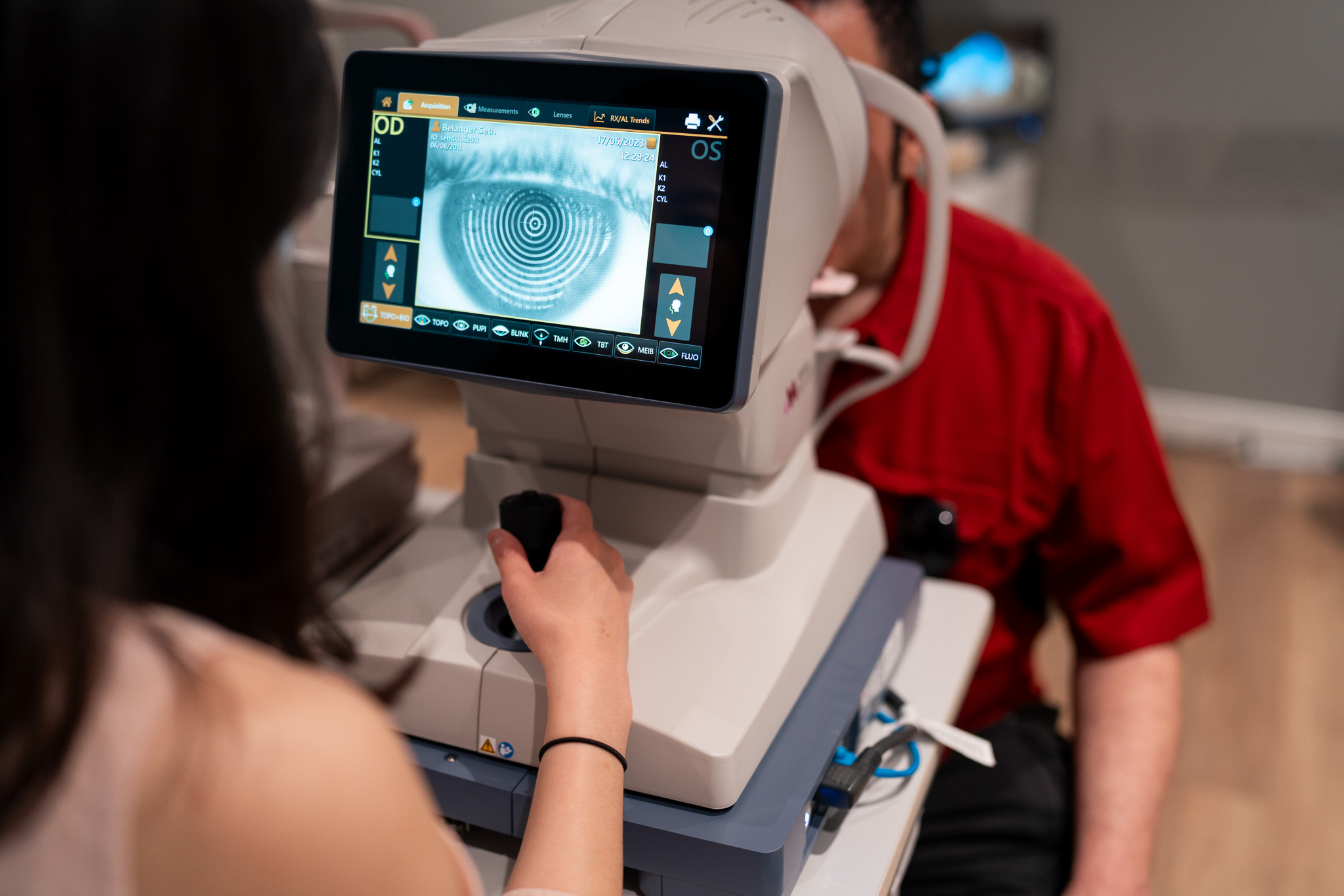
Do you need specialty contact lenses?
When a standard contact lens isn't the answer
Most people do well in off-the-shelf contact lenses, but some don't. A standard lens may not be the answer if one of these applies:
- Your child's prescription climbs every year
- Contact lenses never feel comfortable past mid-afternoon
- You've been told your corneas are difficult to fit
Specialty lenses are custom-made to the measurements of your own eye and fitted by our optometrists at Vision Care Ottawa. Every fitting starts with a candidacy appointment, where one of our doctors tells you honestly whether these lenses are a good option for you.
Specialty lenses
Two paths to clearer vision
What is Ortho-K
Clear vision without daytime glasses or contacts
Think of orthokeratology, or Ortho-K, as retainers for your eyes. Custom lenses worn overnight gently reshape the front surface of the eye while you sleep, so many patients see clearly all day without glasses or contact lenses. Ortho-K is non-surgical and reversible: if you stop wearing the retainers, your eyes gradually return to how they were.
Not everyone is a candidate. Prescription, corneal shape and eye health all matter, and some conditions rule Ortho-K out. That's exactly what the candidacy appointment is for.
Who Ortho-K often suits
Children & teens with progressing myopia
As part of a myopia management plan, to help slow how quickly their prescription changes.
Athletes & active lifestyles
Swimmers, hockey players, dancers and other athletes who'd rather not manage lenses or frames during sport.
Dusty, dry or screen-heavy work
Adults in environments where standard soft contact lenses may feel uncomfortable.
Curious about laser surgery
A reversible, non-surgical way to see clearly without daytime glasses or contacts.
Your Ortho-K journey
From candidacy to clear mornings
Every step is guided by your optometrist, from your first candidacy appointment to your annual renewal.
Candidacy appointment
Your doctor reviews your eye health, maps your cornea and discusses your goals. If Ortho-K isn't right for you, we'll tell you and talk through the alternatives.
Fit and teaching visit
We fit your custom lenses and spend an hour teaching you, or your child, how to handle and care for them safely. Nobody leaves until they can do it themselves.
Follow-up care
We see you the next day, then at one week, one month and six months. Most patients see much of the change within the first week, and the full effect usually settles within two weeks.
Annual renewal
You wear the retainers every night. We replace the lenses each year and monitor your eye health throughout.
What are Scleral Lenses?
Comfort and clarity for complex eyes
A scleral lens is larger than an ordinary contact lens. It vaults over the cornea and rests gently on the white of the eye, called the sclera, holding a thin reservoir of sterile saline against the eye all day. Its smooth surface can sharpen vision that glasses can't correct, and the fluid keeps the eye continuously moist. Many patients who have struggled with other lenses find scleral lenses the most comfortable they've worn.
Who Scleral lenses often suit
Keratoconus & corneal irregularities
A smooth optical surface that can sharpen vision glasses can't correct.
Corneal scarring, transplants or past surgery
Including eyes that have had previous refractive surgery.
Severe or persistent dry eye
And other ocular surface disease, where a fluid reservoir keeps the eye continuously moist.
High or irregular astigmatism
When glasses and standard lenses can't give you steady, comfortable vision.
Eyes that have never tolerated contacts
Many patients who have struggled with other lenses find scleral lenses the most comfortable they've worn.
Scleral lens fitting
What to expect
Fitting scleral lenses is a careful, collaborative process, and we're with you at every step.
Candidacy appointment
Your doctor assesses your cornea and ocular surface. If dryness is part of the picture, our dry eye clinic and lens fitting work together.
Fitting
We fit diagnostic lenses on your eye, then order lenses made to your own measurements. We may try more than one design, and that's a normal part of the process.
Teaching visit
We set aside dedicated time to teach you how to insert and remove the lenses, and you practise with us until you feel confident.
Follow-up care
We monitor fit, comfort, vision and eye health for as long as you wear the lenses.
Start with a candidacy appointment
Every specialty lens journey starts with a dedicated appointment to find out whether these lenses are right for your eyes. It's a clinical assessment, not a sales consultation. Your doctor reviews your eye health and history, takes detailed images of your corneas and talks through your goals and routine. You'll leave with a clear recommendation, any alternatives and a full explanation of costs before you commit to anything. Sometimes the honest answer is that a different option will serve you better.
Prefer to speak to someone first?
Call us at (613) 226-8446 and we'll answer your questions before you book.
FAQ
Questions people ask
Still have questions? We're happy to talk them through before you book.
Ortho-K has been fitted in children for many years as part of myopia management. As with any contact lens, the most important risk is infection, and good hygiene greatly reduces it. That's why we take the time teaching lens care and follow up closely. Your optometrist will review the risks with you at the candidacy visit.
Both aim to provide clear vision without daytime glasses or contacts. Ortho-K is non-surgical and reversible: if you stop wearing the retainers, your eyes return to their starting point over time. Laser surgery is permanent. Your optometrist can explain which options suit your eyes.
Specialty lenses aren't covered by OHIP. Many private insurance plans reimburse part of the cost from receipts, and coverage is often better for medically necessary lenses than for elective fitting. We'll give you an itemized receipt and a letter for your insurer, and our team will help you submit them.
We'll tell you, and use the appointment to discuss and advise what will work instead. We also welcome referrals from other doctors and patients already wearing specialty lenses elsewhere.
Find out what's possible for your eyes.
Book a candidacy appointment with one of our optometrists. Prefer to talk first? Give us a call.